From Impact Data to Social Value Communication
Communicating social impact can build trust and improve brand image. But when done poorly, it can do more harm than good. This case shows how JARstack helped The Social Handprint turn social impact data into practical communication tools for organisations.
In short
The Social Handprint helps organisations measure the social value they create through SDG's. These measured impact values can be difficult to explain because it is often indirect, layered and sensitive to interpretation.
With this project, JARstack helped Social Handprint translate social impact values into a practical communication tool that helps organisations explain, contextualise and share their social value in a responsible manner.
The article explores why social impact communication matters and how poor communication can backfire. It then explains how social impact values can be turned into messages that people can understand and trust.
Social impact does not speak for itself
Measuring social impact can help organisations show the value they create beyond financial results, but that value only becomes useful when people understand what it means.
Communicating impact data
Social impact communication is about showing how an organisation contributes to people or society through social values, instead of financial performance. This can help stakeholders understand the value of the organisation, it can strengthen trust in the brand image, and it makes social contribution more visible.
Communicating social impact is especially relevant for organisations whose value is not fully captured by profit. A social organisation, such as a museum may create value through education, participation, wellbeing or local connection. These contributions are important, but unlike direct financial performance, social impact is often more complicated to communicate. Social impact is usually indirect, spread across different groups and connected to long-term effects. Saying that a project created "€1 million in social value" sounds impressive, but it does not explain whether that value comes from improved mental health, reduced unemployment or stronger communities.
For The Social Handprint, this became the starting point of a challenge. Their method helps organisations make social impact measurable, but they still need to be translated in a way that allows the reader to understand what these values actually mean. Without that translation, measured impact may be visible, but not yet meaningful to the people who need to understand it.
How The Social Handprint measures impact
The Social Handprint created a validated measurement model to provide social impact values, using the Sustainable Development Goals (SDGs) as key metrics. It helps organisations turn their activities and outcomes into an indicated social value, expressed in euros. This measurement is brilliantly named a "handprint". Instead of only saying that an organisation contributes to society, the handprint gives that contribution a measurable form.
Our indicated impact value is €2.421.000
A number like this can create interest, but it also raises questions: Which activities contributed to this value? Which outcomes does it represent? Why should the value be trusted? On its own, an impact value does not yet explain how it should be interpreted. For The Social Handprint, the handprint therefore needed to become more than a measurement of social impact values. It should help organisations and their audience to understand it. Only then can measured impact become more than data; it becomes a value that people can interpret, trust and share.
The risk of communicating impact poorly
It happens often that organisations communicate their social impact towards their audience, only to find out it backfires. When organisations communicate their impact, people do not only look at the claim itself. They also judge whether the claim seems true and sincere. That makes impact communication particularly sensitive. A message that is meant to show positive value can still create doubt when the explanation is unclear, too selective or too strongly framed. This is why social impact communication should be handled responsibly instead of being treated as a simple marketing exercise.
Overclaiming & Greenwashing
When organisations communicate their impact, there is often a temptation to make the message as strong as possible. A large impact value can seem like a powerful proof point, especially when the organisation wants to show funders, partners or the public that their work matters. But a strong claim can also backfire. When people do not understand how these values are calculated or what they include, the message quickly feels too good to be true. In social impact communication, this "overclaiming" often leads to perceived greenwashing or social washing; the feeling that an organisation is trying to appear more socially responsible than it actually is. Greenwashing and social washing can be harmful for a brand, causing people to mistrust the organisation as a whole.
For The Social Handprint, this challenge is especially present because they serve many different organisations, who each contribute to society in their own way. When providing an impact value to these organisations, it is therefore important that they are able to interpret the results and translate them in a way that their audiences don't perceive it as overclaiming. Otherwise, they might fall victim to backfire-effects.
Greenhushing
During social impact communication, organisations have to navigate between high risks and rewards. Because of this, more organisations are becoming increasingly careful with impact communication, to the point where they barely communicate their impact at all. They may fear that their claims sound too big, too commercial, or too difficult to explain. That caution is understandable. But this "greenhushing" also has a cost. If organisations do not communicate their impact, people may never see the value they create. And when valuable work stays hidden, it also becomes harder for others to recognise it, learn from it or follow it.
When social impact becomes visible, it becomes easier for others to follow.
Research suggests that when social impact becomes visible, it can cause others to follow. This can help to set a social norm, where becoming more socially active is more often seen as a minimal requirement, rather than something additional. This is why greenhushing is not only a missed communication opportunity. It can also limit the wider value of social impact, because good examples are less likely to travel beyond the organisation itself.
How to communicate impact clearly
Organisations often get stuck between two risks. If they communicate impact too strongly, people may become sceptical. If they do not communicate it at all, real value stays invisible and nothing is gained. Clear impact communication needs more than a strong number or a positive claim. It should help the reader to interpret it responsibly. Good impact communication does not just say "look what we achieved". It helps people understand what happened, why it matters, and how the claim should be read.
For The Social Handprint, this meant that an impact value should not stand alone. It needed to be explained, placed in context and connected to the method behind it. This helps organisations communicate their value without having to create their own claims from scratch, preventing overclaiming. That became the starting point for JARstack: helping The Social Handprint turn measured impact into a communication tool that gives organisations a safer and more useful way to share their impact value.
Understand the context
When approaching a technological challenge, like translating impact values, it is important to first understand the people behind it. This allow solutions to become human-centered and fit with the needs of the target audience.
Human-centered design
Impact data is only useful when people can make sense of it. A funder, partner, customer or local stakeholder may all look at the same value differently. They do not only ask whether a value is high, but what it means, why it matters and whether they can trust it. The first step in creating fitting communication solutions should therefore always focus on people and to define who the target audience is.
We found that the target audience of The Social Handprint works in two layers. Their clients are the users of the handprint. These organisations receive their social impact value and are free to communicate it as they wish. However, The Social Handprint wants to help these organisations communicate their impact. The second layer therefore consists of the audience of the organisations. They have to eventually read and understand the impact values. A communications tool therefore should be user friendly for the clients, while interpretable for their readers.
By first understanding the target audiences, we already know that the solution has to work for two layers of audiences: the clients and their readers. This simple insight shows the value of human-centered design, to be aligned with the needs of each user.
Data-driven choices
A human-centred approach does not mean ignoring the data. It means analysing the data with the user in mind. For The Social Handprint, this meant looking at what the handprint already contains and how that information is currently structured. That analysis showed that there was no lack of substance. The handprint already had a strong data foundation. The challenge was that much of this value was structured like a report, which can be useful for the first layer of the target audience: the client organisations. However, for the second layer: the audience of each organisation, a report structure is unwanted. External communication needs to guide attention more directly. It should help the reader see the key insight quickly, while still offering a route to the deeper information behind it.
For JARstack, this helped define the direction of the solution. The goal was not to replace the existing handprint or change the way The Social Handprint creates value. The goal was to separate internal communication through the handprint reports and external communication through a new solution. This can help make the existing information easier to read, understand and share.
Theoretical foundation
After understanding the people and the data, we looked at what makes social impact communication effective. We found that it is important for social impact claims to be perceived as trustworthy. This relies on the ability of the reader to understand the message and be guided through interpretation where needed. If people can't interpret the message, it opens the door for misinterpretations, which could ultimately lead to backfire-effects such as perceived greenwashing or social washing.
Trust is a condition for effective social impact communication.
Trust is a matter of perception, which greatly depends on how the message is framed. A claim feels more trustworthy when people can trace where it comes from and see that the value is not presented as an absolute truth. The wording matters here. A small difference between "we are a sustainable organisation" and "our indicated impact value is…" can change how the claim feels.
Transparency and external validation are important drivers of trust. When a reader can easily find how social values came to be, it removes doubt on its formation. An important side note is that the source of these values should be validated. Values that are externally validated are quicker perceived as true, compared to values that originate from the messenger itself. For instance, if a car-dealership says their electric cars can drive further than other models, we may become sceptical. However, when we hear an external party verifying this statement, people trust it significantly quicker.
Organisations should therefore not have to make up their own claims, as this could reduce trust. By using The Social Handprint and their validated underlying handprint methodology as an external verification layer, we could provide prewritten claims for organisations, so they can share their social impact value as responsibly as possible.
Turn insights into practice
The human-centered approach showed us the importance of working with a layered structure. The full handprint could remain the place for depth, detail and accountability. A separate external communication layer could then bring the most important message forward, without asking the reader to process the entire report first.
This direction helped solve two problems at once. Organisations would not have to create their own impact claims from scratch, which lowers the risk of vague or overstated communication. At the same time, the audience would receive a shorter message with enough context to understand what the value means.
From reports to communication cards
To operationalise our findings, the next step was to turn impact data from a report-structure into a cross-media communication tool that is both easy to understand and share. This led to the development of handprint-cards, which form a lightweight communication layer built around the existing handprint structure.
Why handprint cards made sense
After discussing possible directions with the team of Social Handprint, we looked for formats that could make complex data easier to understand and share. One useful source of inspiration was Spotify Wrapped, which displays how personal data can be translated into simple, visual and shareable insights. The comparison was not one-to-one, but the underlying logic was relevant. Both formats would turn fragmented data into a reflection of contribution or achievement. Instead of asking people to study a full dataset, the format brings one insight forward at a time. This gave us a useful starting point; rather than reinventing the wheel, we could apply a familiar communication logic in a new context. That mattered because the goal is to find the highest-value intervention without disrupting the underlying processes and infrastructure.
Low-hanging fruit is about finding the most efficient route for maximum impact.
These non-invasive cards made sense for Social Handprint because they create focus. Instead of showing all data at once, each card highlights one core message. This helps guide interpretation, because the reader is not left to decide which part of the handprint matters most. The format also made the solution more scalable. Social Handprint works with organisations that differ in size, sector and audience, so the output needed to work across different contexts. A card structure offered a low-barrier foundation that is specific enough to communicate value, but flexible enough to use on websites, LinkedIn, reports, presentations or other communication channels. The cards therefore help organisations move from "this is our measured value" to "this is what our value means".
Micro-nudges: designing for clarity
Once the format was clear, the next challenge was to guide interpretation. Small design choices can strongly influence how people read an impact claim. What is shown first, what is made visually dominant and what is kept more subtle all shape the way the message is perceived. One important choice was visual anchoring. Instead of making the organisation itself the central visual element, the cards use societal contribution as the main anchor. The organisation name remains visible, but is placed in a less dominant role. This matters because impact communication can quickly feel self-promotional. When the organisation is visually louder than the contribution, the message may feel like "look at us". By making the social contribution more dominant than the organisation name, the card feels more informative and less like a promotional claim.
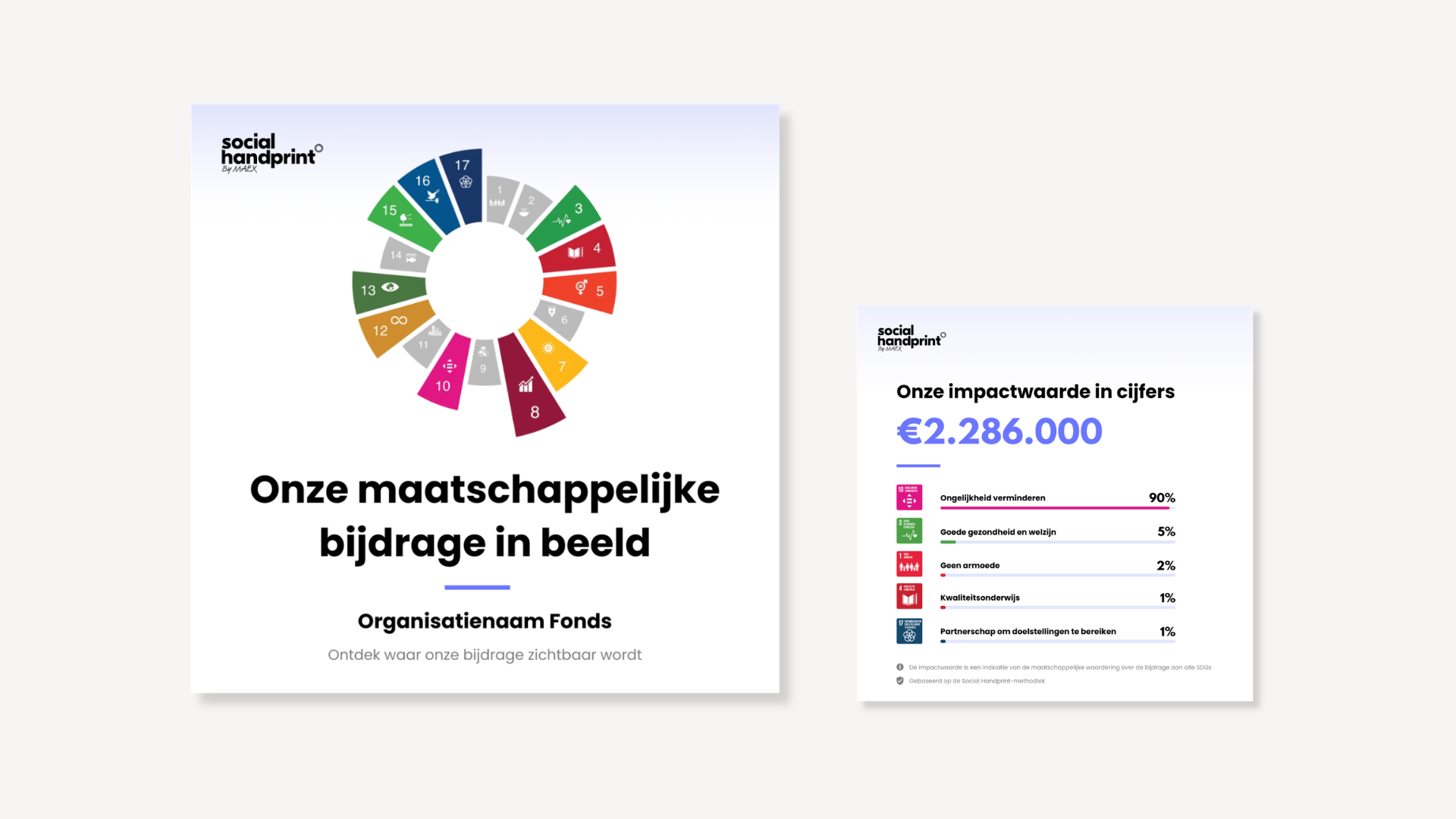
Wording was another important nudge. A phrase like "our indicated impact value" contains two micro-nudges. The clear example is to explicitly mention values as "indications", to highlight they are meant to serve as an indicative number, rather than an absolute value. Using personal wording like "our" is slightly more subtle. This introduces a soft conversational human voice, which can make the message feel more human and approachable, helping to build trust with the reader.
The cards also needed visible trust cues. Social Handprint’s role, logo, and references to underlying methods and information help the reader understand that the value is not just a self-made claim. This suggests that claims are verified by third, external, parties; helping to make a claim significantly more trustworthy. These example illustrate how every single design choices matters, not for decorative purposes but for helping to guide the reader into the desired perception. Each design choice helped reduce noise, guide interpretation and make the impact claim feel easier to understand, verify and share. All of this is done to increase the fundamental factor that allows for effective impact communication: clarity and interpretability of the message.
Comparing impact carefully
One of the strongest ways to make values easier to interpret is by comparison. A value becomes more meaningful when people have a reference point. Without comparison, a reader may see a number, but still not know whether it is high, modest or developing. For the handprint cards, comparison therefore became an important design question. The goal was to help readers place an impact value in context, without creating unfair or misleading comparisons.
The first step was a diagnostic analysis, to understand how the existing data was structured and which meaningful comparisons could be made responsibly. From there, we explored comparison groups based on two layers: organisation type and SDG fit. Organisation type helps compare organisations with a similar role or context. However, not all organisations in a similar industry focus on the same SDG's. For example: one sportsclub might focus on improving sustainability through ecological solutions, while the other might focus on reducing poverty by providing free classes for the youth. Adding the comparative layer by looking at the SDG fit therefore helps to compare organisations with impact around similar societal themes.
This matters because a comparison should not feel like a competitive ranking, by saying who performs the "best". Comparisons should provide context, so readers are able to see how they perform in relation to comparable organisations or similar impact themes, without the message feeling selective or unfair. For Social Handprint, this also created a scalable opportunity. Because the comparison logic is built around existing data flows, it can function as an additional layer rather than a disruption of the current handprint process. As more organisations use Social Handprint, the same logic can help classify and contextualise new handprints more consistently. In that sense, comparison became more than a visual feature. It became a way to turn existing data into new insights, helping organisations understand their impact in context before communicating it externally.
Balancing simplicity and responsibility
The handprints cards are a communication tool that will be used by a diversity of organisations, which means it needs to be easy to use. However, impact communication cannot be simplified without care. If a card is too detailed, people may not undertand it. If it is too simple, the message can lose nuance or feel like an unsupported claim. Due to its subjective nature, there is no right or wrong way to communicate this impact. What matters is to understand which design choices help tell your story in the clearest and most responsible way as possible. A bold claim can create attention, but may also increase scepticism. A detailed explanation can improve transparency, but may reduce readability. The challenge was to find a balance between interest, clarity and responsibility. Which design choices to make therefore depend on the goal of the messenger.
Because of the diversity of Social Handprint's client pool, it was impossible to predetermine which goal each organisation would have by communicating their impact. That is why the cards were divided into different types. Some cards focus on the general impact value, giving organisations a simple way to introduce their measured contribution. Other cards provide more narrative context, showing where the value comes from, which themes it relates to, and how the contribution can be understood. This structure gives organisations more control. They can choose which cards fit their communication context, without having to create their own claims from scratch. This allows organisations to use the cards as added value in multiple contexts, from a website or a LinkedIn post, to a report.
For Social Handprint, this meant that the cards could stay low-barrier without becoming careless. The tool helps organisations communicate their impact in a way that is easier to share, while still keeping the message connected to the data, context and method behind it. This way, a balance was created to serve the goal of making impact values easier to understand without losing what makes it meaningful.
Sustainable value
The handprint cards were designed to solve a specific data-communication gap, but their value goes beyond the cards themselves. They help Social Handprint strengthen the practical use of its methodology, help organisations communicate their impact with more confidence, and create a starting point for making social value more visible and usable over time.
Value for Social Handprint
For Social Handprint, the cards help close the gap between measuring social value and helping organisations communicate it. The cards add a practical communication layer to their existing handprint methodology, to make measured values easier to understand and share. This strengthens the value proposition of Social Handprint. A handprint becomes more than a report or measurement output. It becomes a tool organisations can use in their own communication. That makes the handprint more useful for clients and increases the chance that they continue using it as part of their own impact journey.
The cards also make the role of Social Handprint more visible. When organisations share their cards, the underlying method and source remain connected to the message. This creates additional exposure for Social Handprint, while also helping the audience understand that the value is based on an external method rather than a self-made claim.
Value for organisations
Social value can be difficult to explain, especially when it is expressed through numbers, SDGs, indicators or indirect outcomes. The cards give organisations a guided way to share their value. Instead of having to create their own claims from scratch, they can choose from a set of communication outputs that are already connected to their handprint data. This lowers the barrier to communicate impact in different contexts, such as websites, LinkedIn, reports, presentations or funding applications.
This also helps organisations better understand their own value. By seeing their impact translated into themes, comparisons and narrative cards, they gain a clearer view of what their contribution means. The cards are therefore not only useful for external communication, but can also support internal reflection.
Broader value
The broader value is that social impact becomes easier to recognise, discuss and build upon. When organisations can communicate their contribution more clearly, social value becomes less hidden. It becomes something that stakeholders can act upon.
This matters because visible impact can influence more than one organisation. When social contribution is made understandable, it can help others see what is possible, expected or worth improving. In that sense, better impact communication can contribute to a stronger social norm around creating and sharing societal value.
The handprint cards are also a starting point for a more digital way of working with impact data. Not to control organisations, but to help them understand where they already perform strongly, where improvement is possible, and where support may be valuable. The main lesson from this case is simple. Measuring impact is important, but its value grows when people can understand it, trust it and use it. By bridging this gap, the handprint cards create value for Social Handprint, the organisations that use it, and the readers who see it.
Bridge the gap, JARstack
Do you have any comments or questions about this article, its content, or our services? Please contact us at jarstack.nl